< < SU02.1 : SU03.1 : SU04.1 > >
SU03.1: Data Distribution Implementation
This service package manages the distribution of data from data providers to data consumers and protects those data from unauthorized access. This implementation is a holistic view of the SU02 service package, including all Physical Objects, Functional Objects, and Triples associated with the service package. It distinguishes between items that are fundamental to the service and items that are optional. Your specific implementation is likely to include the fundamental items and selected optional items, based on your specific project requirements.
Relevant Regions: Australia, Canada, European Union, and United States
- Enterprise
- Functional
- Physical
- Goals and Objectives
- Needs and Requirements
- Sources
- Security
- Standards
- System Requirements
Enterprise
Development Stage Roles and Relationships
Installation Stage Roles and Relationships
Operations and Maintenance Stage Roles and Relationships
(hide)
| Source | Destination | Role/Relationship |
|---|---|---|
| Data Distribution System Maintainer | Data Distribution System | Maintains |
| Data Distribution System Manager | Data Distribution System | Manages |
| Data Distribution System Manager | Data Distribution System Operator | System Usage Agreement |
| Data Distribution System Operator | Data Distribution System | Operates |
| Data Distribution System Owner | Data Distribution System Maintainer | System Maintenance Agreement |
| Data Distribution System Owner | Data Distribution System Manager | Operations Agreement |
| Data Distribution System Owner | ITS Object Maintainer | Maintenance Data Exchange Agreement |
| Data Distribution System Owner | ITS Object User | Service Usage Agreement |
| Data Distribution System Owner | Other Data Distribution Systems Maintainer | Maintenance Data Exchange Agreement |
| Data Distribution System Owner | Other Data Distribution Systems Operator | Application Usage Agreement |
| Data Distribution System Owner | Other Data Distribution Systems Owner | Information Exchange Agreement |
| Data Distribution System Owner | Other Data Distribution Systems User | Service Usage Agreement |
| Data Distribution System Supplier | Data Distribution System Owner | Warranty |
| ITS Object Maintainer | ITS Object | Maintains |
| ITS Object Manager | ITS Object | Manages |
| ITS Object Owner | Data Distribution System Maintainer | Maintenance Data Exchange Agreement |
| ITS Object Owner | Data Distribution System Operator | Application Usage Agreement |
| ITS Object Owner | Data Distribution System Owner | Expectation of Information Provision |
| ITS Object Owner | Data Distribution System User | Service Usage Agreement |
| ITS Object Owner | ITS Object Maintainer | System Maintenance Agreement |
| ITS Object Owner | ITS Object Manager | Operations Agreement |
| ITS Object Supplier | ITS Object Owner | Warranty |
| Other Data Distribution Systems Maintainer | Other Data Distribution Systems | Maintains |
| Other Data Distribution Systems Manager | Other Data Distribution Systems | Manages |
| Other Data Distribution Systems Manager | Other Data Distribution Systems Operator | System Usage Agreement |
| Other Data Distribution Systems Operator | Other Data Distribution Systems | Operates |
| Other Data Distribution Systems Owner | Data Distribution System Maintainer | Maintenance Data Exchange Agreement |
| Other Data Distribution Systems Owner | Data Distribution System Operator | Application Usage Agreement |
| Other Data Distribution Systems Owner | Data Distribution System Owner | Information Exchange Agreement |
| Other Data Distribution Systems Owner | Data Distribution System User | Service Usage Agreement |
| Other Data Distribution Systems Owner | Other Data Distribution Systems Maintainer | System Maintenance Agreement |
| Other Data Distribution Systems Owner | Other Data Distribution Systems Manager | Operations Agreement |
| Other Data Distribution Systems Supplier | Other Data Distribution Systems Owner | Warranty |
Functional
This service package includes the following Functional View PSpecs:
Physical
The physical diagram can be viewed in SVG or PNG format and the current format is SVG.SVG Diagram
PNG Diagram
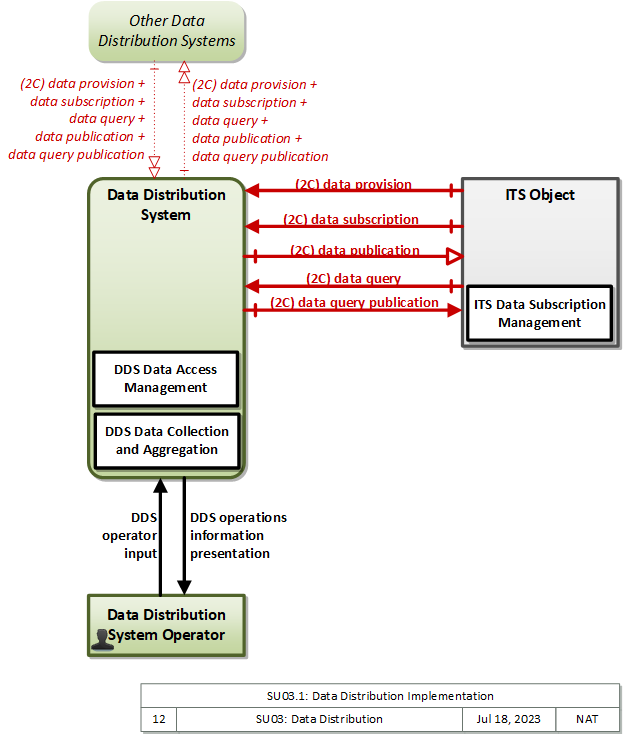

Includes Physical Objects:
| Physical Object | Class | Description |
|---|---|---|
| Data Distribution System | Support | The 'Data Distribution System' collects, processes, and distributes ITS data, connecting data producers with data consumers and facilitating data exchange. |
| Data Distribution System Operator | Support | The 'Data Distribution System Operator' represents the person or people that monitor and manage the data services provided by the Data Distribution System (DDS). These personnel manage and monitor the systems that support the publish/subscribe services of the DDS. |
| ITS Object | ITS | The general 'ITS Object' includes core capabilities common to any class of object. |
| Other Data Distribution Systems | Support | Representing another Data Distribution System, 'Other Data Distribution Systems' is intended to provide a source and destination for information exchange between peer (e.g. inter-regional) data distribution systems. It supports modeling of projects or regions that include multiple interconnected data distribution systems that together manage data distribution in the connected vehicle environment. |
Includes Functional Objects:
| Functional Object | Description | Physical Object |
|---|---|---|
| DDS Data Access Management | 'DDS Data Access Management' defines the access mechanisms, structures and restrictions for inbound (from providers) and outbound (to consumers) data. | Data Distribution System |
| DDS Data Collection and Aggregation | 'DDS Data Collection and Aggregation' collects data 'deposits' from producers including meta data such as the generation location and time. It authenticates and validates the data deposits and logs all associated meta data. Authenticated, valid data is bundled based on information type and location and made available as data products to consumers who are interested in the data. It establishes delivery parameters for data consumers that subscribe based on parameters including content type and geographic region of interest and delivers data to consumers based on these parameters. | Data Distribution System |
| ITS Data Subscription Management | 'ITS Data Subscription Management' manages data subscriptions for an end user. It provides access to a catalog of available data, manages the necessary user information and rules that govern the data subscriptions, supports communications with data providers to collect data per the subscription rules, and makes the data available to the end user. It provides the local user interface through which a user can specify and manage subscriptions. It supports different mechanisms for collecting subscribed data for the end-user including one-time query-response as well as publish-subscribe services. | ITS Object |
Includes Information Flows:
| Information Flow | Description |
|---|---|
| data provision | Data provision provides the source material for a publish-subscribe or query-retrieval data distribution scheme. This is the 1 of the 1:N data distribution architecture. This flow is a super-flow; it does not define data elements but is inclusive of any flow implemented using publish-subscribe or query-retrieval methods. |
| data publication | Data publication includes those dialogs necessary to satisfy the publication portion of a data distribution architecture. The information content varies widely based on available content and the subscription, but it generally includes information on the state of transportation system operations including traffic and road conditions, advisories, incidents, transit service information, weather information, parking information, and other related data. |
| data query | Data query includes those dialogs necessary to determine what data is available for and also submit a query for near-term response. |
| data query publication | Data query publication includes those dialogs necessary to satisfy the response portion of a query-response action using the data distribution architecture. The information content varies widely based on available content and the query, but it generally includes information on the state of transportation system operations including traffic and road conditions, advisories, incidents, transit service information, weather information, parking information, and other related data. |
| data subscription | Data subscription includes those dialogs necessary to determine what data is available for subscription/query, and also the dialogs necessary to create or modify data subscriptions/queries. |
| DDS operations information presentation | Presentation of information to the DDS Operator including current operational status of the Data Distribution System. |
| DDS operator input | User input from the DDS operator including requests to monitor current system operation and inputs to affect system operation. |
Goals and Objectives
Associated Planning Factors and Goals
| Planning Factor | Goal |
|---|---|
| C. Increase the security of the transportation system for motorized and nonmotorized users; | Improve security |
| D. Increase the accessibility and mobility of people and for freight; | Reduce congestion |
| F. Enhance the integration and connectivity of the transportation system, across and between modes, for people and freight; | Enhance integration and connectivity |
| J. Enhance travel and tourism. | Support travel and tourism |
Associated Objective Categories 
| Objective Category |
|---|
| Security: Crime |
| Security: Terrorism, Natural Disasters, and Hazardous Material Incidents |
| Traveler Information: Data Collection and Sharing on Travel Conditions |
Associated Objectives and Performance Measures
Needs and Requirements
| Need | Functional Object | Requirement | ||
|---|---|---|---|---|
| 01 | System Operators, Vehicle Operators, and PID Operators need to be able to request and receive information without establishing formal relationships with data providers. | DDS Data Access Management | 06 | The data support center shall provide metadata parameters (geographic area, data content type, time) as filters for subscription. |
| 07 | The data support center shall provide data consumers with a mechanism for throttling (or reducing) the data they receive as part of subscriptions. | |||
| 08 | The data support center shall provide data consumers with a mechanism for subscribing to data received by the Center. | |||
| 09 | The data support center shall provide a mechanism for the operator to modify data subscriptions. | |||
| DDS Data Collection and Aggregation | 01 | The data support center shall collect data from Vehicles. | ||
| 02 | The data support center shall provide data collection parameters to Vehicles. | |||
| 03 | The data support center shall collect data from Connected Vehicle Roadside Equipment. | |||
| 04 | The data support center shall provide data collection parameters to Connected Vehicle Roadside Equipment. | |||
| 06 | The data support center shall collect data from other Personal Devices. | |||
| ITS Data Subscription Management | 02 | The ITS Object shall allow users to sign up for a data subscription service to access data held by the ITS Object. | ||
| 03 | The ITS Object shall send data to users based upon a set of rules governing the data subscription service. | |||
| 04 | The ITS Object shall support a data subscription service that manages the necessary user information and rules that govern the data subscriptions. | |||
| 05 | The ITS Object shall be capable of collecting data from other ITS Objects to be used as part of the data subscription service. | |||
| 06 | The ITS Object shall maintain a catalog of available data that can be accessed by users of the data subscription service. | |||
| 07 | The ITS Object shall send a data query to a data subscription service. | |||
| 08 | The ITS Object shall subscribe to a data subscription service. | |||
| 09 | The ITS Object shall receive published data from a data subscription service. | |||
| 02 | System Operators need to be able to provide data to a geographically selected area. | DDS Data Access Management | 01 | The data support center shall distribute to personal devices data which has been validated, aggregated, integrated, and sanitized. |
| 02 | The data support center shall distribute to Vehicles data which has been validated, aggregated, integrated, and sanitized. | |||
| 04 | The data support center shall distribute to Vehicles broadcast data which has been validated, aggregated, integrated, and sanitized. | |||
| 05 | The data support center shall distribute to Connected Vehicle Roadside Equipment data which has been validated, aggregated, integrated, and sanitized. | |||
| ITS Data Subscription Management | 03 | The ITS Object shall send data to users based upon a set of rules governing the data subscription service. | ||
| 03 | Data Distribution Operators need to be able to exchange data with other data distribution systems. | DDS Data Collection and Aggregation | 05 | The data support center shall collect data from other Centers. |
| ITS Data Subscription Management | 01 | The ITS Object shall support peer-to-peer communications with other ITS Objects to support operational data sharing. | ||
| 04 | Data Distribution Operators need to be able to establish and maintain data processing algorithms, rules and related metadata, including all those processes related to Validation, Integration, Sanitization, and Aggregation. | DDS Data Access Management | 03 | The data support center shall distribute to other Centers data which has been validated, aggregated, integrated, and sanitized. |
| DDS Data Collection and Aggregation | 07 | The data support center shall perform 'VISA' functions on incoming data (VISA = Validation, Integration, Sanitization, Aggregation). | ||
| 08 | The data support center shall provide a mechanism for the operator to control data collection parameters. | |||
| 09 | The data support center shall provide a mechanism for the operator to modify VISA functions. | |||
Related Sources
| Document Name | Version | Publication Date |
|---|---|---|
| None |
Security
In order to participate in this service package, each physical object should meet or exceed the following security levels.
| Physical Object Security | ||||
|---|---|---|---|---|
| Physical Object | Confidentiality | Integrity | Availability | Security Class |
| Data Distribution System | High | High | Moderate | Class 4 |
| ITS Object | High | High | Moderate | Class 4 |
| Other Data Distribution Systems | High | High | Moderate | Class 4 |
In order to participate in this service package, each information flow triple should meet or exceed the following security levels.
| Information Flow Security | |||||
|---|---|---|---|---|---|
| Source | Destination | Information Flow | Confidentiality | Integrity | Availability |
| Basis | Basis | Basis | |||
| Data Distribution System | Data Distribution System Operator | DDS operations information presentation | Moderate | High | High |
| System core flows should have some protection from casual viewing, as otherwise imposters could gain illicit control over core equipment | Backoffice operations flows should generally be correct and available as these are the primary interface between operators and system. | Backoffice operations flows should generally be correct and available as these are the primary interface between operators and system. | |||
| Data Distribution System | ITS Object | data publication | High | High | Moderate |
| This value is derived from the specific flows satisfied by this super-flow. HIGH is set because some flows may require it. If the implementation includes flows with only a MODERATE or LOW confidentiality requirement, then this could be MODERATE or LOW, as appropriate. | This value is derived from the specific flows satisfied by this super-flow. HIGH is set because some flows may require it. If the implementation includes flows with only a MODERATE integrity requirement, then this could be MODERATE. | This value is derived from the specific flows are satisfied by this super-flow. MODERATE is set because some flows may require it. If the implementation includes flows with only a LOW availability requirement, then this could be LOW. HIGH is not considered; any flow requiring HIGH availability will not use DDS. | |||
| Data Distribution System | ITS Object | data query publication | High | High | Moderate |
| This value is derived from the specific flows satisfied by this super-flow. HIGH is set because some flows may require it. If the implementation includes flows with only a MODERATE or LOW confidentiality requirement, then this could be MODERATE or LOW, as appropriate. | This value is derived from the specific flows satisfied by this super-flow. HIGH is set because some flows may require it. If the implementation includes flows with only a MODERATE or LOW integrity requirement, then this could be MODERATE or LOW, as appropriate. | Query flows need some level of abailability; if the flow is not satisifed the user may be become frustrated and seek a solution other than DDS. Thus MODERATE. | |||
| Data Distribution System | Other Data Distribution Systems | data provision | High | High | Moderate |
| This value is derived from the specific flows satisfied by this super-flow. HIGH is set because some flows may require it. If the implementation includes flows with only a MODERATE or LOW confidentiality requirement, then this could be MODERATE or LOW, as appropriate. | This value is derived from the specific flows satisfied by this super-flow. HIGH is set because some flows may require it. If the implementation includes flows with only a MODERATE integrity requirement, then this could be MODERATE. | This value is derived from the specific flows are satisfied by this super-flow. MODERATE is set because some flows may require it. If the implementation includes flows with only a LOW availability requirement, then this could be LOW. HIGH is not considered; any flow requiring HIGH availability will not use DDS. | |||
| Data Distribution System | Other Data Distribution Systems | data publication | High | High | Moderate |
| This value is derived from the specific flows satisfied by this super-flow. HIGH is set because some flows may require it. If the implementation includes flows with only a MODERATE or LOW confidentiality requirement, then this could be MODERATE or LOW, as appropriate. | This value is derived from the specific flows satisfied by this super-flow. HIGH is set because some flows may require it. If the implementation includes flows with only a MODERATE integrity requirement, then this could be MODERATE. | This value is derived from the specific flows are satisfied by this super-flow. MODERATE is set because some flows may require it. If the implementation includes flows with only a LOW availability requirement, then this could be LOW. HIGH is not considered; any flow requiring HIGH availability will not use DDS. | |||
| Data Distribution System | Other Data Distribution Systems | data query | High | Moderate | Moderate |
| Query flows imply the interests of the source. Observation of this information betrays the privacy of the requestor. Depending on the type of requestor and type of Query flows imply the interests of the source. Observation of this information betrays the privacy of the requestor. Depending on the type of requestor and type of information requested, this could be MODERATE.information requested, this could be MODERATE. | Query flows create long term relationships between source and DDS, and dictate what information the source receives. Corruption of this flow could have a significant impact on data reception; however, re-query should be a fairly simply process, justifying MODERATE and not HIGH. | Query flows need some level of abailability; if the flow is not satisifed the user may be become frustrated and seek a solution other than DDS. Thus MODERATE. | |||
| Data Distribution System | Other Data Distribution Systems | data query publication | High | High | Moderate |
| This value is derived from the specific flows satisfied by this super-flow. HIGH is set because some flows may require it. If the implementation includes flows with only a MODERATE or LOW confidentiality requirement, then this could be MODERATE or LOW, as appropriate. | This value is derived from the specific flows satisfied by this super-flow. HIGH is set because some flows may require it. If the implementation includes flows with only a MODERATE or LOW integrity requirement, then this could be MODERATE or LOW, as appropriate. | Query flows need some level of abailability; if the flow is not satisifed the user may be become frustrated and seek a solution other than DDS. Thus MODERATE. | |||
| Data Distribution System | Other Data Distribution Systems | data subscription | High | High | Moderate |
| This value is derived from the specific flows satisfied by this super-flow. HIGH is set because some flows may require it. If the implementation includes flows with only a MODERATE or LOW confidentiality requirement, then this could be MODERATE or LOW, as appropriate. | This value is derived from the specific flows satisfied by this super-flow. HIGH is set because some flows may require it. If the implementation includes flows with only a MODERATE or LOW integrity requirement, then this could be MODERATE or LOW, as appropriate. | This value is derived from the specific flows are satisfied by this super-flow. MODERATE is set because some flows may require it. If the implementation includes flows with only a LOW availability requirement, then this could be LOW. HIGH is not considered; any flow requiring HIGH availability will not use DDS. | |||
| Data Distribution System Operator | Data Distribution System | DDS operator input | Moderate | High | High |
| System core flows should have some protection from casual viewing, as otherwise imposters could gain illicit control over core equipment | Backoffice operations flows should generally be correct and available as these are the primary interface between operators and system. | Backoffice operations flows should generally be correct and available as these are the primary interface between operators and system. | |||
| ITS Object | Data Distribution System | data provision | High | High | Moderate |
| This value is derived from the specific flows satisfied by this super-flow. HIGH is set because some flows may require it. If the implementation includes flows with only a MODERATE or LOW confidentiality requirement, then this could be MODERATE or LOW, as appropriate. | This value is derived from the specific flows satisfied by this super-flow. HIGH is set because some flows may require it. If the implementation includes flows with only a MODERATE integrity requirement, then this could be MODERATE. | This value is derived from the specific flows are satisfied by this super-flow. MODERATE is set because some flows may require it. If the implementation includes flows with only a LOW availability requirement, then this could be LOW. HIGH is not considered; any flow requiring HIGH availability will not use DDS. | |||
| ITS Object | Data Distribution System | data query | High | Moderate | Moderate |
| Query flows imply the interests of the source. Observation of this information betrays the privacy of the requestor. Depending on the type of requestor and type of information requested, this could be MODERATE. | Query flows create long term relationships between source and DDS, and dictate what information the source receives. Corruption of this flow could have a significant impact on data reception; however, re-query should be a fairly simply process, justifying MODERATE and not HIGH. | Query flows need some level of abailability; if the flow is not satisifed the user may be become frustrated and seek a solution other than DDS. Thus MODERATE. | |||
| ITS Object | Data Distribution System | data subscription | High | High | Moderate |
| This value is derived from the specific flows satisfied by this super-flow. HIGH is set because some flows may require it. If the implementation includes flows with only a MODERATE or LOW confidentiality requirement, then this could be MODERATE or LOW, as appropriate. | This value is derived from the specific flows satisfied by this super-flow. HIGH is set because some flows may require it. If the implementation includes flows with only a MODERATE or LOW integrity requirement, then this could be MODERATE or LOW, as appropriate. | This value is derived from the specific flows are satisfied by this super-flow. MODERATE is set because some flows may require it. If the implementation includes flows with only a LOW availability requirement, then this could be LOW. HIGH is not considered; any flow requiring HIGH availability will not use DDS. | |||
| Other Data Distribution Systems | Data Distribution System | data provision | High | High | Moderate |
| This value is derived from the specific flows satisfied by this super-flow. HIGH is set because some flows may require it. If the implementation includes flows with only a MODERATE or LOW confidentiality requirement, then this could be MODERATE or LOW, as appropriate. | This value is derived from the specific flows satisfied by this super-flow. HIGH is set because some flows may require it. If the implementation includes flows with only a MODERATE integrity requirement, then this could be MODERATE. | This value is derived from the specific flows are satisfied by this super-flow. MODERATE is set because some flows may require it. If the implementation includes flows with only a LOW availability requirement, then this could be LOW. HIGH is not considered; any flow requiring HIGH availability will not use DDS. | |||
| Other Data Distribution Systems | Data Distribution System | data publication | High | High | Moderate |
| This value is derived from the specific flows satisfied by this super-flow. HIGH is set because some flows may require it. If the implementation includes flows with only a MODERATE or LOW confidentiality requirement, then this could be MODERATE or LOW, as appropriate. | This value is derived from the specific flows satisfied by this super-flow. HIGH is set because some flows may require it. If the implementation includes flows with only a MODERATE integrity requirement, then this could be MODERATE. | This value is derived from the specific flows are satisfied by this super-flow. MODERATE is set because some flows may require it. If the implementation includes flows with only a LOW availability requirement, then this could be LOW. HIGH is not considered; any flow requiring HIGH availability will not use DDS. | |||
| Other Data Distribution Systems | Data Distribution System | data query | High | Moderate | Moderate |
| Query flows imply the interests of the source. Observation of this information betrays the privacy of the requestor. Depending on the type of requestor and type of information requested, this could be MODERATE. | Query flows create long term relationships between source and DDS, and dictate what information the source receives. Corruption of this flow could have a significant impact on data reception; however, re-query should be a fairly simply process, justifying MODERATE and not HIGH. | Query flows need some level of abailability; if the flow is not satisifed the user may be become frustrated and seek a solution other than DDS. Thus MODERATE. | |||
| Other Data Distribution Systems | Data Distribution System | data query publication | High | High | Moderate |
| This value is derived from the specific flows satisfied by this super-flow. HIGH is set because some flows may require it. If the implementation includes flows with only a MODERATE or LOW confidentiality requirement, then this could be MODERATE or LOW, as appropriate. | This value is derived from the specific flows satisfied by this super-flow. HIGH is set because some flows may require it. If the implementation includes flows with only a MODERATE or LOW integrity requirement, then this could be MODERATE or LOW, as appropriate. | Query flows need some level of abailability; if the flow is not satisifed the user may be become frustrated and seek a solution other than DDS. Thus MODERATE. | |||
| Other Data Distribution Systems | Data Distribution System | data subscription | High | High | Moderate |
| This value is derived from the specific flows satisfied by this super-flow. HIGH is set because some flows may require it. If the implementation includes flows with only a MODERATE or LOW confidentiality requirement, then this could be MODERATE or LOW, as appropriate. | This value is derived from the specific flows satisfied by this super-flow. HIGH is set because some flows may require it. If the implementation includes flows with only a MODERATE or LOW integrity requirement, then this could be MODERATE or LOW, as appropriate. | This value is derived from the specific flows are satisfied by this super-flow. MODERATE is set because some flows may require it. If the implementation includes flows with only a LOW availability requirement, then this could be LOW. HIGH is not considered; any flow requiring HIGH availability will not use DDS. | |||
Standards
The diagram here shows the primary standards associated with the physical objects and information flows in this service package. Click on the standard # to go to the page explaining that standard in more detail. The tables that follow the diagram list the standards associated with the information flows in this service package that should drive development decisions. Click on the standard name for more information from the Communications View about a particular standard, including the solutions and information flow triples associated with the standard and any gaps or overlaps. This table is based primarily on standards used in North America. For information concerning standards and communications solutions in other regions consult the Communications View.
This material should be considered 'draft for review' and may change separately from ARC-IT version revisions. The date on the diagram relates to the date of the physical service package diagram on which this is based; standards-related information should be considered up-to-date as of the 'last updated' date on this page.
Communication Standards: Standards associated with data, message or dialog definitions, communications protocols and management and security of data exchanges. All standards here are also illustrated in information flow triple communications view diagrams.
| Name | Title |
|---|---|
| Facilities Layer | |
| Apache Kafka | Apache Kafka |
| Apache Zookeeper | Apache Zookeeper |
| DDS | Data Distribution Service |
| DDS-RPC | Remote Procedure Call Over DDS (DDS-RPC) |
| DDS-RTPS | Real-Time Publish-Subscribe Wire Protocol DDS (TM) Interoperability Wire Protocol (DDSI-RTPS (TM)) |
| Zenoh | Eclipse Zenoh |
| Security Entity | |
| DDS-Security | DDS Security |
| IETF RFC 8446 TLS | The Transport Layer Security (TLS) Protocol |
| Networking and Transport Layer | |
| IETF RFC 768 UDP | User Datagram Protocol |
| IETF RFC 9293 TCP | Transmission Control Protocol |
| IP Alternatives | Internet Protocol Alternative Set |
| Access Layer | |
| Internet Subnet Alternatives | Internet Subnet Alternatives |
| Wireless Internet Alternatives (NA) | Wireless Internet Alternatives according to North American standards |
Physical Standards: Standards associated with device physical, environmental or performance requirements.
No physical standards have been identified for this service package.
Service-Level Standards: Standards associated service package structure, messaging patterns, user needs, requirements or similar systems-engineering content that describe one or more use cases satisfied by the service package.
No service-level standards have been identified for this service package.
System Requirements
| No System Requirements |